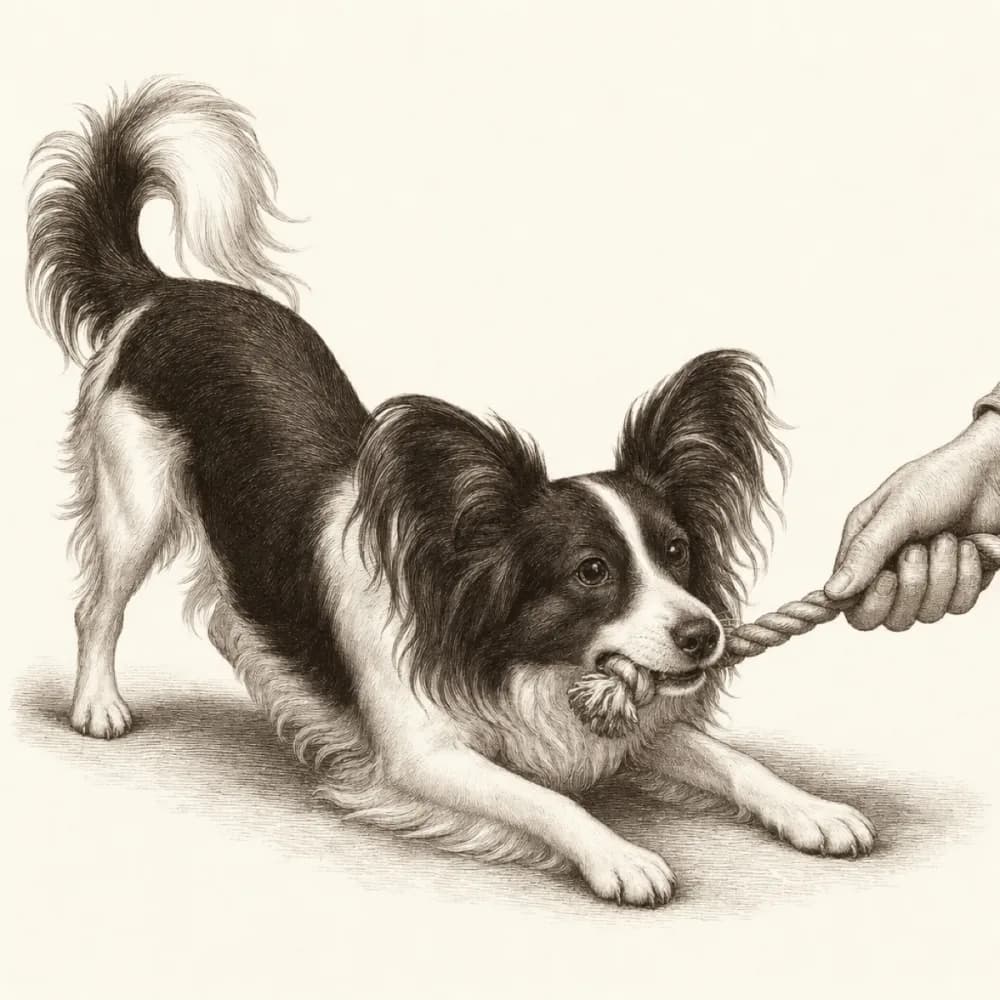
Play
Play is fun. Most owners use it as a break from training. We use it as the most powerful daily tool we have.
A dog plays for joy, not for food. If the joy comes through you, you become a primary reward yourself.
Why play matters
Play is the only time most dogs feel pure positive emotion with the owner. Meals are need. Walks are mixed. Grooming is calm.
Play is joy. We use it to bond.
Stages 1, 2, and 7 of the test improve fast when play changes.
Sub-principles
- You start the game. You end the game.
- The toy moves because of you.
- Short games. Many a day.
- The dog asks for the next game by looking at you.
Practice steps
Step 1 — Pick one toy (first week)
- Choose one toy. A rope, a soft toy, a tug.
- Keep it on a shelf. The dog cannot reach it without you.
- Play with it twice a day for two minutes each time.
- After play, the toy goes back on the shelf.
The toy now lives with you. The dog cannot get joy from it without you.
Step 2 — Make the toy move (second week)
- Sit on the floor. Drag the toy slowly along the ground.
- Do not throw it across the room. Do not wave it in the air.
- The toy moves like a small animal. Stops. Starts. Hides under your leg.
- The dog will pounce, chase, grab.
When the dog grabs, hold the other end. A small tug. Then let the dog have it for five seconds. Take it back. Move it again.
You are the reason the toy is interesting.
Step 3 — The trade rule (third week)
- The dog has the toy. You want it back.
- Hold the toy still. Do not pull.
- Wait. The dog will let go in a few seconds.
- The moment the dog lets go, the game starts again.
Do not say "drop." Do not pry the mouth. Do not offer food. The trade is: let go, and the game continues.
Step 4 — Stop on a look (fourth week)
- During play, freeze. Hold the toy still.
- The dog will stare, then look at your face.
- The moment the dog looks at your face, the toy moves again.
Now the dog has learned that the gateway to play is your face.
This is the same gateway as feeding and walking. The dog learns once and applies everywhere.
Step 5 — Short games, often (second month)
- Play for one to two minutes, five to ten times a day.
- Each game starts with the dog asking — a look at you, a glance at the shelf.
- Each game ends with you, not the dog. The toy goes back.
A long game tires the dog and dulls the joy. A short game leaves the dog wanting more.
Step 6 — Play in new places (third month)
- Bring the toy to the yard, the park, a friend's home.
- The toy means the same thing in every place: joy through you.
- Start with one minute. Build up.
A dog that plays with you in a busy park is a dog that is bonded outside.
Common mistakes
- Leaving toys on the floor. Toys lose value. Joy comes from the floor, not from you. Keep toys on the shelf.
- Throwing the ball over and over. This builds drive, not bond. Use ball-throw sparingly. Tug and chase with you in the loop are stronger.
- Letting the dog win every time. A real game has trades. The dog should let go and want the toy back.
- Long, tiring play. A tired dog is not bonded. A dog that wants more is.
Signs of progress
- The dog watches the shelf where the toy lives.
- The dog brings the toy to you, not to the room.
- The dog drops the toy on a quiet stop.
- On the test, stages 1, 2, and 7 move from no to yes.
Play is the easiest activity to start. Begin here if you are new and the rest feels like too much.