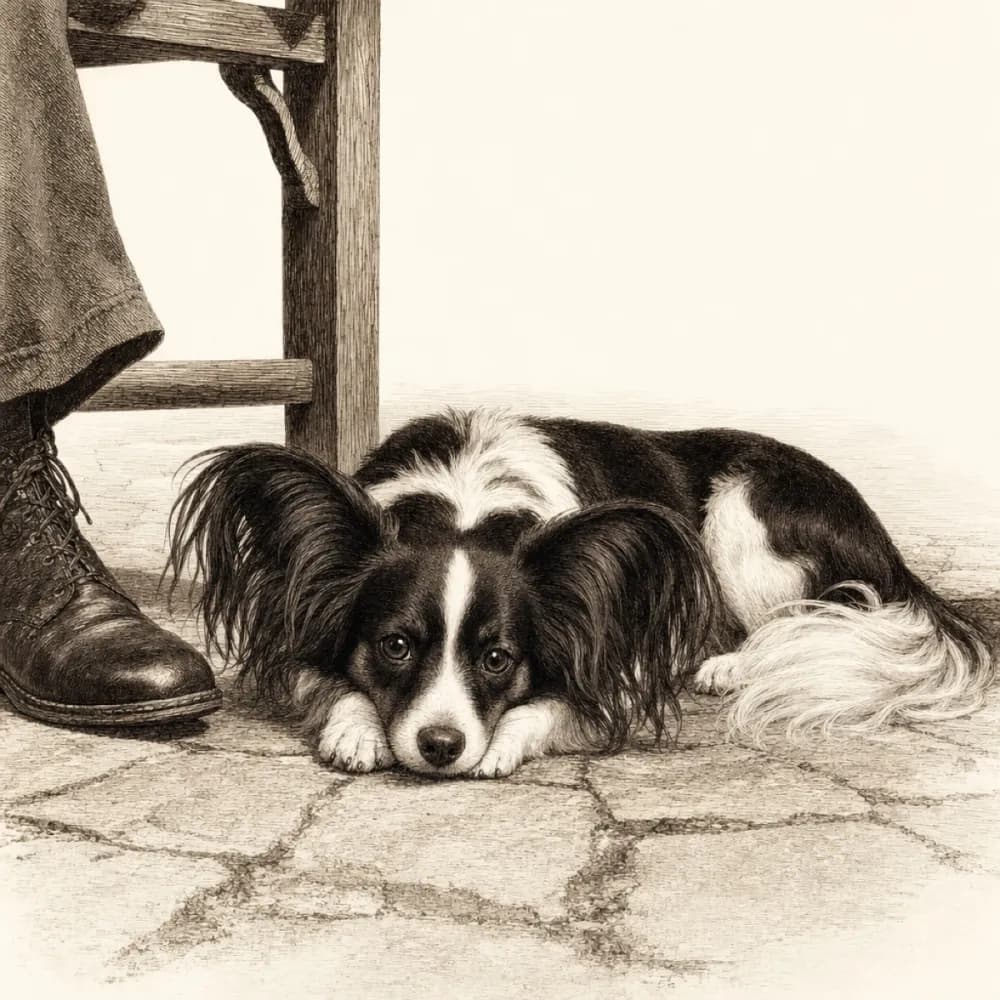
Manners outside
Outside the home there are people, dogs, food on the ground, sounds, smells, and rules that change room to room. Most dogs guess at what to do. The owner reacts.
We replace the guessing with a small set of rules. The rules do not change with the place. The dog reads the owner, not the room.
Why manners matter
A dog with manners outside is a dog you can take anywhere. That means more time with you, in more places. More time together is more bond.
Stages 5, 6, 9, and 10 of the test live here.
Sub-principles
- The dog watches you, not the room.
- The same rule runs in every place.
- New places are short visits at first.
- People who ignore the dog are friends. People who reach for the dog are managed.
Practice steps
Step 1 — The settle (first week)
A "settle" is the dog lying down within an arm's length of you and staying there.
At home:
- Sit on the couch with a book or your phone.
- The dog has a leash on, fastened to your foot or a nearby chair.
- Wait. Do not look at the dog. Do not talk to the dog.
- The dog will try things. Pacing, whining, pawing, then lying down.
- When the dog lies down, do nothing. That is the win.
- Sit for ten minutes. Then end.
Do this twice a day for a week. Add five minutes a week until you reach thirty minutes.
Step 2 — The settle in a quiet outside place (second week)
- Pick a quiet bench, a tree in the yard, a slow café.
- Same rules: leash on you, no talking, no looking.
- Five minutes the first day. Add minutes as the dog settles faster.
This is stage 5 of the test, practiced.
Step 3 — The greeting rule (third week)
- A person wants to pet the dog. They say hi. They reach.
- You stop. You ask the person to wait.
- The dog must sit and look at you. Then look at the person.
- Then the person can pet the dog under the chin or on the chest. Not on top of the head.
If the dog jumps or paws, the greeting ends. The person walks away. Try again next time.
This rule is the same with friends, strangers, and family.
Step 4 — Food on the ground (fourth week)
City streets have food on the ground. A dog that grabs food on the street is a dog that is not yet bonded outside.
- Walk past a small piece of food. Keep walking.
- If the dog goes for it, stop. Walk in an arc.
- Do not yell. Do not yank.
- Try again with a smaller piece, farther away.
When the dog passes food without breaking the loose leash, the rule is in.
Step 5 — The new place protocol (second month)
A new place is hard. Use a fixed protocol.
- Walk around the outside of the place for two minutes.
- Enter and stop near the door. Wait for the dog to settle for one minute.
- Move to your seat or the room. Settle.
- Stay short on the first visit. Ten to fifteen minutes.
- Leave before the dog gets tired or excited.
Each new place gets the same five steps. The protocol is the rule. It does not change.
Common mistakes
- Letting strangers feed the dog. The dog learns that strangers are food gateways. Your value drops.
- Long first visits. A dog overwhelmed in a new place will be worse the next time. Short and calm wins.
- Telling friends to "give the dog space" with anger. Polite is fine. Calm is fine. The dog reads your tone, not your words.
- Different rules for different rooms. A dog allowed on the couch at home but yelled at on a café chair is confused. Pick one rule.
Signs of progress
- The dog settles within two minutes in a new place.
- The dog ignores food on the ground on most walks.
- The dog looks at you before greeting any person.
- On the test, stages 5, 6, 9, and 10 move from no to yes.
This is the longest activity. Plan for six months of regular practice.